

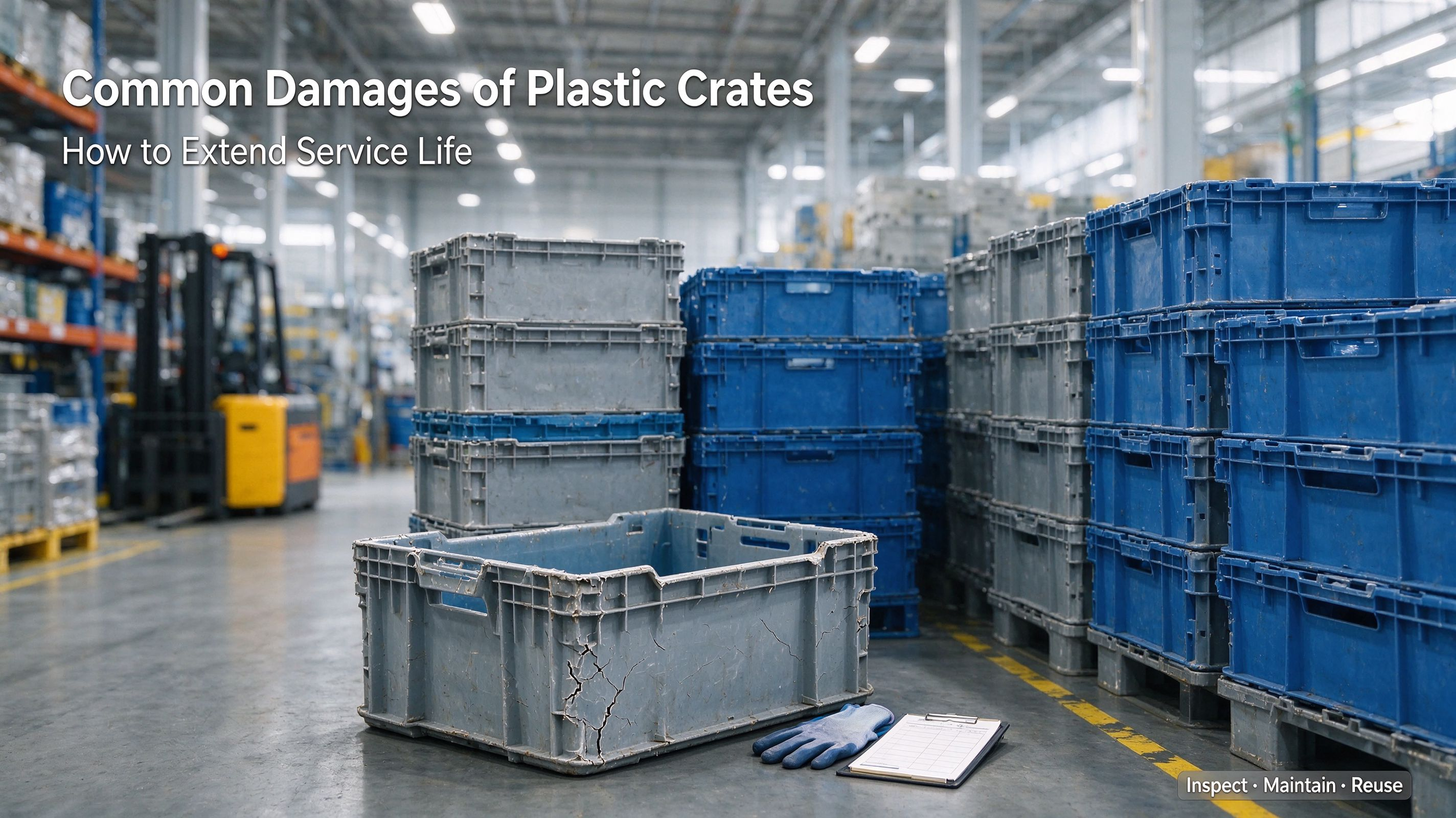
Plastic crates are the backbone of modern material handling, widely used in warehousing, agriculture, food distribution and manufacturing. Whether you use solid stackable crates or collapsible crates, these reusable plastic crate containers endure repeated stacking, transport and manual handling. Even high-quality HDPE and PP plastic crates will suffer premature damage without proper operation and routine inspection. Learning common failure modes and preventive measures helps reduce replacement costs and keep your plastic crate fleet in safe circulation.
!
Common Damages to Plastic Crates
01 Edge Cracks & Wall Breakage
Impact from forklift forks, dropping from pallet height or dragging crates on rough concrete floors is the primary cause of rim and wall cracks. Overloading also creates continuous stress on crate walls. For collapsible crates, corners and hinge joints are extra vulnerable to impact damage. Minor surface scratches do not affect performance, but through-wall cracks or multiple broken sections mean the plastic crate must be retired immediately to avoid collapse during stacking.
02 UV Aging & Brittleness
Long-term outdoor exposure causes UV degradation. The surface of plastic crates gradually turns chalky, and the polymer becomes brittle, prone to cracking even under light impact. This damage cannot be fully repaired. Both stackable crates and collapsible crates will age faster when stored continuously under direct sunlight.
03 Permanent Deformation
Excessive stacking height, overweight loading or storage in high-temperature enclosed warehouses will lead to bent walls and uneven crate bases. Deformed plastic crates lose stable stacking performance. Stackable crates rely on matched top and bottom interlock; once warped, they can no longer stack safely.
04 Handle & Hinge Failure
Molded handles on standard plastic crates often crack when operators lift overweight crates with only one handle. For collapsible crates, folding hinges and side locking latches are high-wear components. Repeated folding cycles and impact can loosen or crack hinges, disabling the assembly function.
05 Chemical Contamination
Grease, strong solvents and corrosive liquids can soften and weaken HDPE or PP material. For food-grade plastic crates, leftover organic residue builds up and accelerates material wear while creating hygiene risks.
✓
Practical Ways to Extend Service Life
• Follow marked maximum load limits. Distribute goods evenly inside each plastic crate, avoid concentrated heavy loads.
• Avoid dragging loaded crates on the ground; prevent forklift forks striking crate edges. Lift plastic crates using two hands.
• Store crates indoors whenever possible. Select UV-stabilized plastic crates for outdoor applications. Rotate stock to reduce sun exposure.
• Observe manufacturer stacking height limits. Do not stack loaded stackable crates or assembled collapsible crates beyond recommended levels.
• Perform regular pre-use inspection. Check cracks, deformation, and handle integrity. Remove severely damaged units from circulation.
• Clean plastic crates after each cycle with mild detergent, remove debris and avoid contact with incompatible chemicals.
“With consistent maintenance, premium plastic crates can serve 5–10 years in normal industrial circulation. Timely inspection protects warehouse staff and optimizes ROI for your stackable crates and collapsible crates.”
Post time: Nov-27-2026


