

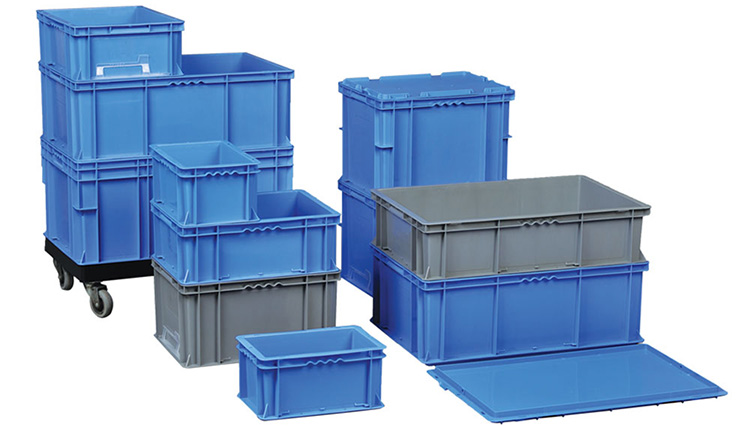
When selecting the size of stackable crates, several factors need to be considered to ensure efficiency and economy in practical applications.
The characteristics of the stored items are a key factor. The size, shape, and weight of the items directly affect the choice of crates. For example, fragile or easily deformable items require appropriately sized crates to provide sufficient support and prevent damage under pressure during stacking. The weight distribution of the items also needs attention; excessively heavy items may require crates with greater load-bearing capacity, which will affect the size design, such as thickening the crate walls or adjusting the height.
Space utilization is another important aspect. The core advantage of stackable crates lies in their stacking capability, therefore the size must match the storage space. In warehouses or on shelves, the length, width, and height of the crates should be coordinated with the shelf dimensions to innovatively utilize vertical and horizontal space. For example, if the shelf height is limited, choosing shorter crates can increase the number of stacking layers; conversely, in high-ceiling warehouses, taller crates can reduce the floor space occupied. The stability of empty crates when stacked also depends on the size design; appropriate dimensions can prevent tilting or collapse during stacking.
Transportation and handling requirements also influence size selection. In logistics, boxes must be compatible with pallets, vehicles, or conveyor systems. Standard pallet sizes, such as 1200mm x 1000mm, require boxes to be arranged neatly on the pallet to avoid wasted space. For manual handling, the weight and size of the boxes must be ergonomic; for example, medium-sized boxes are generally easy for one person to handle, while large boxes may require mechanical assistance.
Cost factors are also significant. Larger boxes may have higher initial purchase costs, but reducing the total number of boxes can lead to overall cost savings in the long run. Size standardization can reduce customization and replacement costs. Within a budget, choosing common box sizes is often more economical because market supply is ample and prices are relatively stable.
Environmental and usage adaptability is equally important. For example, in humid or temperature-sensitive environments, dimensional stability must account for the thermal expansion and contraction of materials; in cleanrooms or the food industry, the size design must facilitate cleaning and sterilization, which may affect the internal structure and height of the boxes.
Post time: Dec-05-2025


