

Outdoor trash cans are the cornerstone of urban environmental sanitation management, widely deployed in municipal roads, residential communities, parks, and other public areas. As a standardized container for garbage collection and transportation, they play a vital role in preventing environmental pollution caused by random littering, while adapting to complex outdoor scenarios with their durability and corrosion resistance.
■
HDPE Material: The Core of Durability for Outdoor Trash Cans
The main body of most outdoor trash cans is made of High-Density Polyethylene (HDPE), a thermoplastic resin known for its outstanding impact resistance, acid and alkali resistance, and moisture-proof and rust-proof properties. Through one-piece injection molding technology, the thickness of the barrel can reach 20mm, effectively withstanding external collisions, long-term exposure to sunlight and rain, and even extreme temperatures ranging from -30℃ to 65℃. The barrel is designed with a wide-top and narrow-bottom structure, with a widened base to enhance stability, and the opening adopts arc-shaped edges to avoid scratching users, ensuring both safety and practicality.
■
Capacity and Specifications: Matching Different Scenario Needs Scientifically
The capacity of outdoor trash cans directly affects their use efficiency, and the selection must be based on on-site conditions such as pedestrian flow and garbage collection frequency to avoid overflow or resource waste. Common specifications include 50L, 120L, 240L, and 660L: the 240L model can hold about 6 standard garbage bags, making it suitable for areas with moderate daily garbage output such as residential communities and parks; the 660L model is designed for high-traffic areas with large garbage generation, such as commercial streets and large event venues. For low-traffic areas like small parks or residential walkways, smaller capacities such as 45L or 50L are more appropriate, ensuring rational use of resources.
■
Customization Design: Flexible Adaptation to Aesthetics and Functions
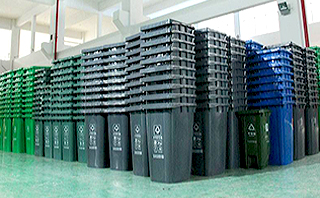
To meet the diverse needs of different public spaces, outdoor public trash cans support flexible customization in terms of color and function. In line with garbage classification policies, common color schemes include green for recyclables, gray for other garbage, and red for hazardous waste, helping to guide public garbage sorting behavior. In addition, the barrel body can be equipped with identification stickers or luminous strips to improve visibility at night, while some models can be added with high-bearing silent wheels for easy movement and transportation, or locks to prevent random rummaging of garbage. The production cycle for customized orders is usually within 72 hours, ensuring timely delivery for sanitation management needs.
■
Usage and Maintenance: Key Tips to Extend Service Life
Proper use and regular maintenance are essential to extend the service life of outdoor public trash cans. The smooth surface of HDPE material makes it easy to clean — it can be wiped with neutral detergent, and strong acids or alkalis should be avoided to prevent material damage. In winter, it is necessary to prevent water accumulation in the barrel from freezing and cracking the barrel body; in summer, prolonged exposure to direct sunlight should be avoided to slow down material aging. Regular cleaning not only prevents odor and bacterial growth but also maintains the appearance of the trash cans, making them integrate better with the urban environment.
Outdoor public trash cans are not only functional sanitation equipment but also an “invisible business card” of urban civilization, integrating practicality, durability, and aesthetics. With the continuous improvement of urban environmental requirements, the demand for high-quality, customizable outdoor public trash cans will continue to grow, providing strong support for building a cleaner and more beautiful urban living environment.
Post time: Mar-13-2026


