

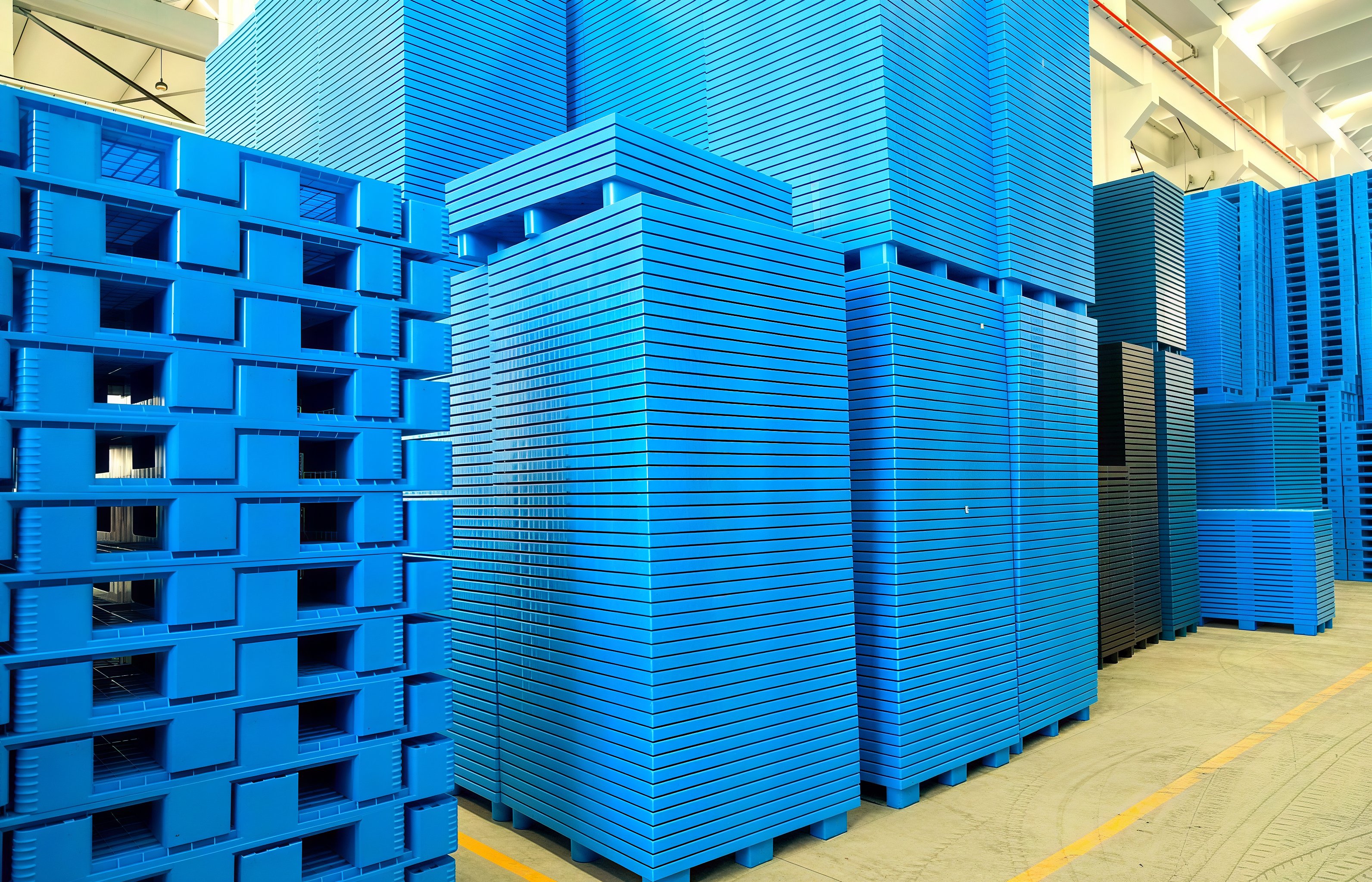
Recycled HDPE (rHDPE) plastic pallets are manufactured from post-industrial or post-consumer HDPE waste. The waste plastic goes through sorting, shredding, washing, re-melting and re-pelletizing before injection molding. Every thermal recycling cycle shortens polymer molecular chains and downgrades mechanical performance, known as downcycling. Even well-sorted single-stream recycled HDPE shows weaker performance than virgin HDPE, while mixed contaminated scrap brings severe batch instability.
Advantages of Qualified Recycled HDPE Pallets
Lower initial procurement cost
Recycled HDPE raw material costs less, helping customers cut capital expenditure for large-volume general circulation pallets.
Eco-friendly for ESG and green supply chains
Using qualified recycled HDPE diverts plastic waste from landfills and reduces virgin resin consumption. It works well for companies aiming to meet sustainability targets.
Decent chemical resistance
(clean single-source regrind) If feedstock is strictly sorted to pure HDPE without PP, PET or PVC impurities, recycled HDPE still maintains acceptable acid and alkali resistance for ordinary industrial environments.
⚠️ Hidden Risks of Recycled HDPE Pallets (Buyer Focus)
Repeated heating reduces impact strength. Poorly mixed recycled materials may lose 20%–35% of impact resistance. It is common that actual load capacity is 15%–30% lower than labelled ratings.
Recycled HDPE becomes brittle quickly in freezing conditions. Forklift impact or stacking weight easily creates cracks in cold rooms.
Mixed scrap may contain residual oil, chemicals or foreign polymer impurities. Recycled HDPE pallets generally cannot pass food-contact certification.
Standard recycled HDPE pallets usually last 3–6 years. Frequent replacement may increase total cost despite the cheap unit price.
Some sellers disguise blended or full-regrind pallets as virgin HDPE. Visual inspection alone cannot reliably confirm the raw material composition.
Practical Ways to Identify Recycled HDPE Pallets
Note: These methods are field reference only. Laboratory testing is the authoritative verification standard.
- [1] Surface and color check: Most low-grade recycled pallets look dull and matte, with uneven color, scattered black specks, pinholes or flow marks.
- [2] Odor check: Low-quality recycled pallets often release sharp, oily or sour smells from degraded plastic and residual pollutants.
- [3] Fracture cross-section observation: Inspect a broken sample edge. Recycled HDPE cross-sections are rough with visible impurity particles and voids.
- [4] Certificates and load test reports: Ask for ISO 8611 test documents. If a supplier cannot provide records, the risk rises significantly.
- [5] NIR laboratory analysis: Near-infrared testing can accurately detect foreign polymer contamination and measure blending ratios.
Suitable Scenarios for Recycled HDPE Pallets
Recycled HDPE pallets are only recommended under these conditions:
Post time: Nov-20-2026


