

In the fields of modern logistics, warehousing, and industrial manufacturing, pallet boxes are indispensable loading and turnover tools. Among them,solid plastic pallet boxes have become the mainstream choice for heavy-duty cargo handling scenarios due to their core advantages of stable structure and strong load-bearing capacity. This article focuses on the characteristics, application scenarios, and maintenance points of solid pallet container, providing references for selection in industries such as industrial manufacturing and food processing.
I. Key features of solid pallet boxes
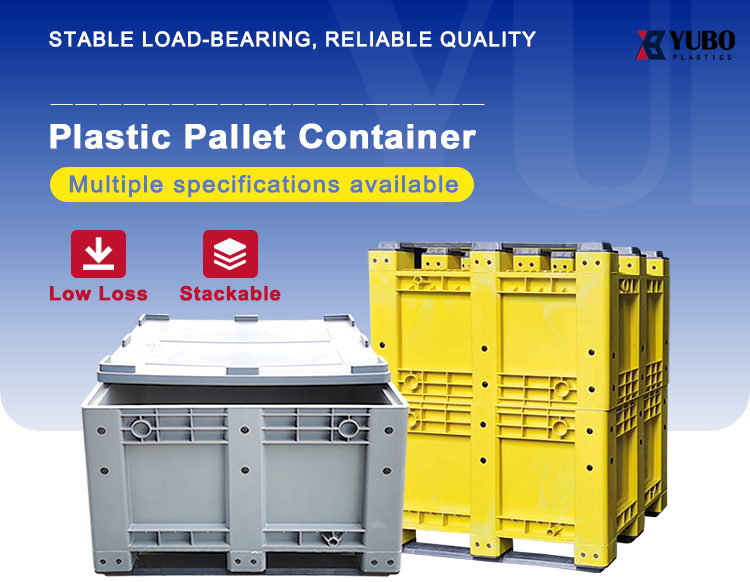
The biggest advantage of solid pallet boxes lies in their integrated structural design, where the pallet and the box body are seamlessly connected without splicing gaps. When under force, it can achieve uniform force transmission, effectively avoiding local deformation and damage caused by uneven force, and its load-bearing performance is far superior to that of ordinary spliced pallet boxes.
In terms of materials and craftsmanship, most one-piece pallet boxes adopt an integral injection molding process, with low-pressure high-density polyethylene (HDPE) as the main material. This material has the characteristics of acid and alkali resistance, leakage prevention, impact resistance, and high strength, which can not only adapt to complex industrial working conditions but also meet the hygiene requirements of the food industry, suitable for turnover use in multiple environments.
In terms of maintenance and cleaning, solid pallet boxes have a simple structure and a smooth surface, which is not easy to get stained or accumulate dust. Daily cleaning only requires wiping with clean water or neutral detergent, no complex disassembly is needed, the maintenance cost is low, and the service life can be effectively extended.
II. Main Application Scenarios of solid pallet container
The industrial manufacturing field is the core application scenario of pallet boxes, especially suitable for heavy industries such as automobile manufacturing and machinery manufacturing. The turnover of parts on the production line and the packaging and transportation of finished products all require tools with strong load-bearing capacity and stable structure. Solid pallet boxes can ensure that heavy parts are not damaged during turnover, ensuring the smooth progress of the production process.
In the food processing industry, plastic pallet boxes meet food safety standards by virtue of their non-toxic, harmless, and easy-to-clean advantages. They are widely used in the warehousing and transportation of beverages, cans, and other foods, which can effectively isolate pollution, protect food quality, and adapt to the strict hygiene control requirements of the food industry.
In the field of logistics and distribution, solid pallet boxes are easy to stack in multiple layers, suitable for large cargo and long-distance transportation scenarios. They can reduce the shaking and loss of goods during transportation, improve the efficiency of transportation loading, and reduce the comprehensive cost of long-distance logistics, making them the preferred tool for large logistics enterprises to handle heavy cargo.
III. Selection Suggestions
If it is necessary to handle heavy cargo, long-term storage, or adapt to complex working conditions, solid pallet boxes are the best choice. The combination of their integrated structure and high-quality materials can balance load-bearing capacity and durability, adapt to various industrial, logistics, and food scenarios with high stability requirements, and help improve work efficiency.
Post time: Jan-30-2026


