

Warehouse space is one of the most expensive projects in the supply chain. According to industry analysis, replacing mixed wooden or cardboard boxes with standardized stackable crates can increase the cube utilization rate by 10% to 35%, depending on the current unitization process and SKU combination. For distribution centers with low profits, this improvement is sufficient to change their profitability. What are the core advantages of stackable crates in warehouse storage?
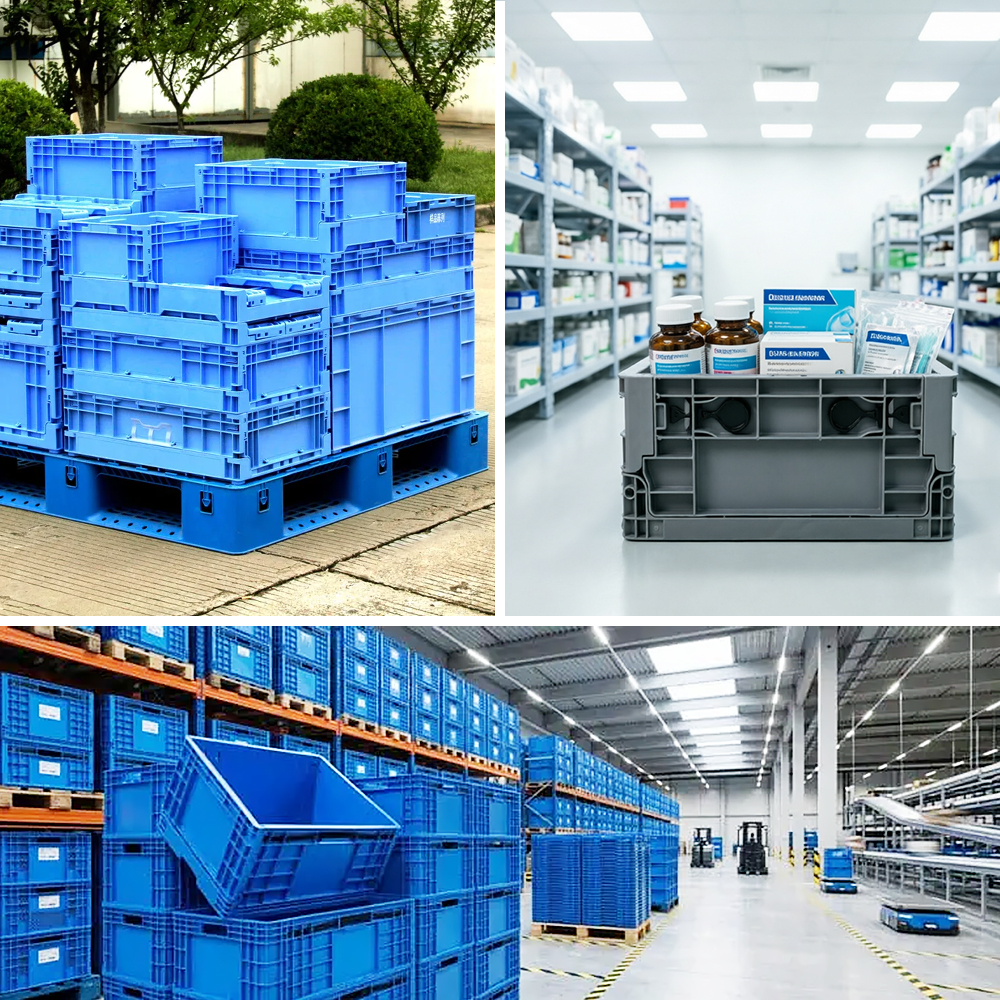
The most immediate benefit of stackable crates is their ability to convert unused vertical airspace into productive storage. Reinforced edges and interlocking rims allow loaded crates to stack safely — typically 5 to 6 units high for medium-duty models — without the risk of collapse or lateral shifting.
Standardized footprints such as the Euro-standard 600 × 400 mm align perfectly with 1200 × 800 mm and 1200 × 1000 mm pallets, as well as automated storage and retrieval systems (AS/RS). This compatibility eliminates manual repositioning and accelerates inventory rotation. On the flip side, poorly matched crate specifications can disrupt material flow and increase handling costs by 15–25%, so footprint standardization matters from day one.
Many stackable crates are also nestable: when empty, a 180° rotation lets them slide inside one another, dramatically reducing the volume they occupy. Industry data shows consistent savings across manufacturers:
For reverse logistics — the empty trip back to a distribution hub — this means a single truck can carry roughly three times as many empty containers compared with rigid, non-nestable alternatives. Some nestable pallet systems even shift the return ratio from 1:1 to as high as 6:1. The result is lower freight costs, fewer return trips, and faster crate turnover.
Single-use cardboard may look cheap on a per-unit purchase order, but the math changes once you account for repeated trips. A FEFCO–Deloitte case study models reusable plastic crates at 25 use cycles before breakage, while other lifecycle assessments assume reusable boxes can last 50 uses or more.
The Food and Agriculture Organization (FAO) found that in fresh-produce supply chains comparing bamboo baskets, wooden crates, and plastic crates, plastic crates had the lowest unit packaging cost when reuse cycles were factored in. They are also approximately 30% lighter than metal crates, reducing manual handling strain and transportation weight.
The trade-off is upfront capital: plastic crates carry a higher acquisition cost and are roughly 40% heavier than cardboard. The economic case therefore depends on achieving a high enough turnover rate to amortize the initial investment.
Stackable plastic crates resist moisture, corrosion, and common warehouse chemicals — properties that cardboard and untreated wood cannot match. Smooth, non-porous surfaces are washable and fast-drying, making vented and solid-wall models suitable for food, pharmaceuticals, and perishables where hygiene is audited.
Durable construction also means fewer damaged goods in transit. Reusable food-grade crates provide consistent containment across the supply chain, reducing product loss compared with corrugated boxes that weaken when wet or over-stacked.
Post time: Aug-21-2026


